

What Is B2B SaaS? Strong Definition, Benefits, Real World Examples



What Is B2B SaaS? Definition, Benefits, Real World Examples
The way businesses buy and use software has changed dramatically over the last decade. Gone are the days of expensive one-time license fees, on-site server rooms, and months-long implementation projects. Today, the dominant model is B2B SaaS, and if you run or work in a modern business, you're almost certainly already using it. In this guide, we'll break down exactly what B2B SaaS means, how it works, why it's grown so explosively, and what benefits it delivers to businesses of every size.
What Does B2B SaaS Mean?
B2B SaaS stands for Business-to-Business Software as a Service. Let's unpack that:
- B2B (Business-to-Business) means the software is designed to be sold from one business to another — not to individual consumers.
- SaaS (Software as a Service) means the software is hosted in the cloud and delivered over the internet, rather than installed locally on a computer or server.
Put them together and you get cloud-based software that companies subscribe to in order to run their operations — from sales and marketing to HR, finance, and customer support. Instead of purchasing a perpetual licence, businesses pay a recurring monthly or annual subscription fee to access and use the platform.
How Does B2B SaaS Work?
At its core, B2B SaaS is powered by cloud infrastructure. A vendor builds and hosts the software on servers (often provided by platforms like Amazon Web Services, Microsoft Azure, or Google Cloud), and customers access it through a web browser or a dedicated application, with no installation required.
Here's a simplified look at the typical B2B SaaS workflow:
- A business identifies a need (e.g., managing customer relationships, automating invoices, or tracking projects).
- They sign up for a SaaS product that addresses that need and choose a subscription plan.
- Users log in from any device with an internet connection and begin using the software immediately.
- The vendor continuously updates the platform, handles security, and manages infrastructure in the background.
This model benefits both sides: businesses get powerful software without heavy upfront costs or IT overhead, and vendors build predictable, recurring revenue streams.
Key Characteristics of B2B SaaS
What sets B2B SaaS apart from traditional software? Several defining features make it uniquely suited for business environments:
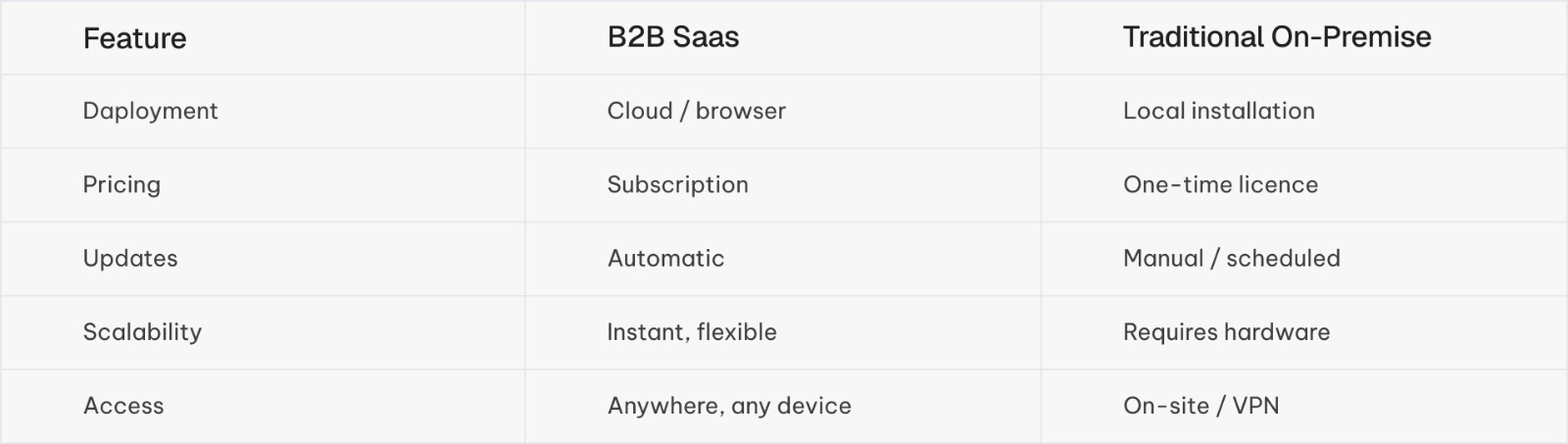
1. Subscription-Based Pricing - Rather than a large one-time purchase, users pay predictable monthly or annual fees. This lowers the barrier to entry and makes budgeting far more manageable.
2. Cloud-Hosted & Accessible Anywhere - Because the software lives in the cloud, teams can access it from any device, anywhere in the world. This is especially critical in today's era of remote and hybrid work.
3. Automatic Updates & Maintenance - The vendor takes full responsibility for updates, bug fixes, and security patches. Businesses always have access to the latest version without lifting a finger.
4. Scalability - B2B SaaS solutions grow with your business. You can add or remove users, upgrade or downgrade plans, and expand functionality as your needs evolve — paying only for what you use.
5. Seamless Integrations - Most B2B SaaS tools offer open APIs and pre-built integrations with other popular platforms, allowing businesses to connect their tech stack and create efficient workflows.
Real-World Examples of B2B SaaS
B2B SaaS touches virtually every function within a modern organisation. Here are some widely recognised examples across different business categories:
- CRM (Customer Relationship Management): Salesforce, HubSpot
- Project Management: Asana, Monday.com, Trello
- Communication & Collaboration: Slack, Microsoft Teams, Zoom
- Finance & Accounting: QuickBooks Online, Xero, FreshBooks
- Human Resources: BambooHR, Workday, Gusto
- Marketing Automation: Mailchimp, ActiveCampaign, Marketo
- Customer Support: Zendesk, Freshdesk, Intercom
Each of these platforms is used by businesses — not consumers — to streamline operations, improve team performance, and drive growth.
Key Benefits of B2B SaaS for Businesses
- The rapid adoption of B2B SaaS is no accident. Businesses of all sizes, from startups to global enterprises are drawn to the model for tangible, practical reasons: Lower Upfront Costs
- Traditional software required large capital expenditures on licences, hardware, and implementation. B2B SaaS eliminates most of that, replacing unpredictable costs with a flat, manageable subscription.
- Faster Time to Value: Implementation that once took months can now take days or even hours. Teams get up and running quickly, and businesses start seeing results sooner.
- Reduced IT Burden: Maintaining on-premise software requires dedicated IT staff and resources. With SaaS, the vendor manages infrastructure, freeing your internal team to focus on higher-value work.
- Data Security & Backup: Reputable B2B SaaS providers invest heavily in enterprise-grade security: data encryption, single sign-on (SSO), role-based access control, and compliance with regulations such as GDPR, HIPAA, and SOC 2.
- Continuous Innovation: Because SaaS vendors compete on product quality, they continuously improve their platforms. Customers benefit from new features and performance improvements regularly — without paying for a new version.
B2B SaaS vs Traditional Software: A Quick Comparison
Common Challenges to Be Aware Of
B2B SaaS is not without its limitations. Businesses evaluating SaaS solutions should be mindful of:
- Vendor lock-in: Migrating data from one platform to another can be complex and time-consuming.
- Internet dependency: A reliable internet connection is essential; outages can disrupt access.
- Customisation limits: Highly niche workflows may not be fully supported by off-the-shelf SaaS tools.
- Data privacy: Sensitive data stored in the cloud requires careful review of a vendor's security and compliance certifications.
These challenges are manageable, but they underscore the importance of thorough due diligence before committing to any platform.
The B2B SaaS Market
The B2B SaaS market is growing at a remarkable pace. Industry research indicates the global SaaS market is projected to approach $0.4 trillion in 2025, driven by accelerating cloud adoption, digital transformation initiatives, and AI integration within software platforms. Organisations worldwide now use an average of over 130 software applications — the vast majority of them delivered via SaaS.
AI-powered features, vertical SaaS solutions built for specific industries (healthcare, legal, construction), and usage-based pricing models are among the most significant trends shaping the space right now.
Conclusion
B2B SaaS has fundamentally transformed how businesses access and use technology. By shifting software delivery to the cloud and adopting a subscription model, it has democratised access to powerful tools that were once only available to large enterprises with deep pockets.
Whether you're a startup looking to scale efficiently or an established company modernising your tech stack, understanding B2B SaaS is the first step toward making smarter software decisions. The right SaaS tools won't just improve your operations — they'll give your business a competitive edge in an increasingly digital world.
Looking for a Professional SaaS Website Template?
Now that you understand what B2B SaaS is and the value it delivers, you might be wondering how to present your own SaaS product professionally online. A well-designed SaaS website template can be the difference between a visitor bouncing and a lead converting.
At Webocean, we offer premium SaaS website templates crafted specifically for B2B software companies, startups, and digital agencies. Whether you're launching a new SaaS product or refreshing an existing site, our templates are built with the following in mind:
- Clean, conversion-focused layouts designed for SaaS landing pages
- Mobile-responsive design that looks great on every device
- Fast-loading, SEO-friendly code structure out of the box
- Customisable sections: hero, features, pricing, testimonials, CTA, and more
- Compatible with modern web technologies and easy to integrate with your stack
You don't need to start from scratch. Our SaaS templates give you a strong, professional foundation so you can focus on what matters most: building and growing your product.
👉 Explore our SaaS templates at: Webflow Template Store, Interesting 10 SAAS Template, or Webflow SAAS Template
From sleek one-page designs to multi-section SaaS product pages, Webocean has a template that fits your brand and goals. Browse the full collection and find the perfect starting point for your next SaaS website today.





